Artificial intelligence is changing how construction teams estimate project costs in 2026. AI construction estimating can help contractors analyze drawings, perform quantity takeoffs, organize project data, and prepare bids faster. Tools such as AI takeoff software can identify items on digital plans and assist with automated quantity takeoff, reducing some of the repetitive work that estimators handle every day.
AI is also being used to study historical project data, support cost forecasting, and improve digital estimating workflows. These changes are part of the wider construction technology trends in 2026, where automation and data-driven tools are becoming more common.
However, AI construction cost estimating is not simply about letting software produce a final number. AI can assist with measurements, data analysis, and calculations, but experienced estimators still need to review drawings, specifications, pricing, scope, and project conditions. The most practical approach is AI-assisted estimating, where technology supports professional construction judgment rather than replacing it.
What Is AI Construction Estimating?

AI construction estimating is the use of artificial intelligence to assist with construction cost estimating tasks such as drawing analysis, quantity takeoffs, cost data processing, and project cost forecasting. Instead of handling every step manually, estimators can use digital tools to process large amounts of project information and speed up repetitive work.
Several technologies support this process. Machine learning can identify patterns in historical project data and support cost prediction. Computer vision can recognize objects, measurements, and building elements in construction drawings. Predictive analytics can help analyze past costs and project data to forecast possible outcomes. Generative AI can also assist with document analysis, summaries, and other estimating tasks.
The goal is AI-assisted estimating, where technology supports the estimator rather than making every decision independently.
How AI Construction Estimating Works
A typical workflow looks like this:
Construction drawings → AI analysis → Quantity extraction → Cost data → Estimate → Human review
AI can help extract quantities and organize information, while an estimator checks the results, reviews specifications, applies suitable pricing, and considers project conditions.
AI Estimating vs Traditional Estimating
Traditional estimating depends more heavily on manual drawing review, measurement, data entry, and calculations. AI-assisted estimating automates parts of this work, allowing estimators to spend more time on scope, pricing, risk, and professional judgment.
Why AI Is Becoming Important in Construction Estimating
Construction projects are becoming more detailed, and estimating teams often have to review large drawing sets, specifications, revisions, and project data in limited time. Repetitive measurement and quantity takeoff work can add to the estimating workload, especially when several bids are due at once.
At the same time, material prices and labor costs can change, making current cost data important for reliable estimates. Contractors also need faster bid turnaround to respond to opportunities without sacrificing careful review.
AI can help by processing large volumes of information, assisting with measurements, organizing cost data, and supporting digital estimating workflows. This is part of the wider digital transformation in construction.
The main benefit is not simply speed. AI reduces repetitive work so estimators can spend more time on analysis and decision-making. Experienced professionals can focus on scope, pricing, project conditions, risk, and other factors that require construction knowledge.
How AI Is Used in Construction Cost Estimating

AI is becoming useful across several parts of the construction cost estimating process. It can review drawings, identify building elements, extract quantities, organize cost data, and support faster estimate preparation. The goal is not to remove the estimator, but to reduce repetitive work.
Automated Quantity Takeoff
AI quantity takeoff tools can assist with measuring walls, doors, windows, floor areas, concrete, roofing, electrical symbols, and MEP components. This creates a faster digital takeoff workflow. For example, Trimble uses AI to detect and count construction objects and assist with drawing scale detection. ([trimble.com])
AI Blueprint and Drawing Analysis
AI can support AI blueprint analysis through drawing recognition, object detection, plan classification, scale detection, and revision comparison. This helps teams review large drawing sets more efficiently.
AI Construction Estimating Software
Modern AI construction estimating software can bring takeoffs, measurements, cost databases, labor rates, material pricing, estimate templates, bid preparation, and document management into one workflow.
Automated Cost Estimating
A simple calculation is quantity × unit cost = basic cost. A complete estimate also considers labor, equipment, subcontractors, waste, overhead, location, project conditions, risk, and profit.
AI and Material Pricing
AI can help organize supplier pricing, historical pricing, regional cost data, labor rates, and cost databases. However, estimators should verify that pricing reflects current local market conditions before using it in a final bid.
Machine Learning Cost Prediction in Construction
Machine learning cost prediction uses historical project data to identify patterns that can support construction cost prediction and construction cost forecasting. Instead of relying only on a single past project, predictive models can compare many data points to produce a more informed cost outlook.
Depending on the available data, a model may consider:
- Project type and size
- Project location
- Material costs
- Labor costs
- Project duration
- Previous estimates and project costs
- Economic indicators
This supports predictive cost modeling and predictive construction cost estimating, especially during early project planning when detailed information may not yet be available.
However, a prediction is only as useful as the data behind it. The quality, relevance, and freshness of the data directly affect the usefulness of the result. Current market conditions, local pricing, unusual project requirements, and changes in labor or material costs still need professional review before a forecast is used for an important construction decision.
AI Construction Estimating for Different Project Types
AI can support estimating across different construction project types, but its value depends on the project’s size, complexity, and available data. Simple and repetitive scopes are often easier to process, while complex projects need more expert review.
AI in Residential Estimating
For homes, remodeling, and additions, AI can help review smaller drawing sets and identify repetitive scopes such as rooms, walls, doors, windows, flooring, and finishes. This can make takeoff work more efficient, especially when similar layouts are repeated. ([Eano])
AI in Commercial Estimating
Commercial projects usually involve larger drawing sets, multiple trades, frequent revisions, and detailed scope. AI can help organize drawings, identify building elements, and support quantity extraction, while estimators handle coordination and scope review.
AI in Industrial Estimating
Industrial estimating can involve MEP systems, equipment, piping, structural work, and specialized requirements. These projects often need closer human review because systems and specifications can vary greatly. AI can assist with repetitive tasks, but experienced estimators remain important for interpreting complex scope and project requirements.
AI for Construction Quantity Takeoffs
AI is making construction quantity takeoffs faster by helping estimators review drawings, identify materials, and organize quantities. It can support both simple and complex takeoff work while reducing repetitive measurement and data entry.
AI Material Takeoffs
AI material takeoffs can identify items and calculate quantities for materials used across different trades. This supports drywall estimating, flooring estimating, concrete estimating, and roofing estimating.
AI Blueprint Takeoffs
AI can analyze digital plans and help locate building elements, measurements, and drawing details. This can make AI blueprint takeoffs more efficient, especially with large plan sets.
AI Concrete Takeoffs
For concrete estimating, AI can assist with measurements for slabs, foundations, footings, and other concrete elements.
AI Roofing and Lumber Takeoffs
AI can help organize roof areas and lumber quantities, supporting faster roofing estimating and framing takeoffs.
AI MEP Takeoffs
AI can also support electrical estimating, plumbing estimating, and mechanical estimating by identifying relevant components and quantities. However, complex MEP systems still require experienced review to confirm scope, specifications, and final quantities.
BIM Cost Estimating and AI
BIM cost estimating combines digital building information with quantities and cost data to create a more connected estimating process. Building Information Modeling (BIM) provides structured project information that AI can analyze, organize, and use to support faster quantity and cost reviews.
A simple way to understand 5D BIM is:
3D model + quantities + cost data = 5D BIM
How AI Works With BIM
With AI BIM, software can work with structured model information to identify building elements, extract quantities, and support cost analysis. This makes BIM quantity takeoff and model-based estimating more efficient.
Revit estimating is another important application. Revit and other model-based workflows can provide detailed information for quantity extraction and cost planning. DFE’s BIM estimating services support Revit and AutoCAD models, 5D cost models, and projects ranging from LOD 100 through LOD 500, helping connect digital models with professional construction estimating.
AI Estimating vs Traditional Estimating
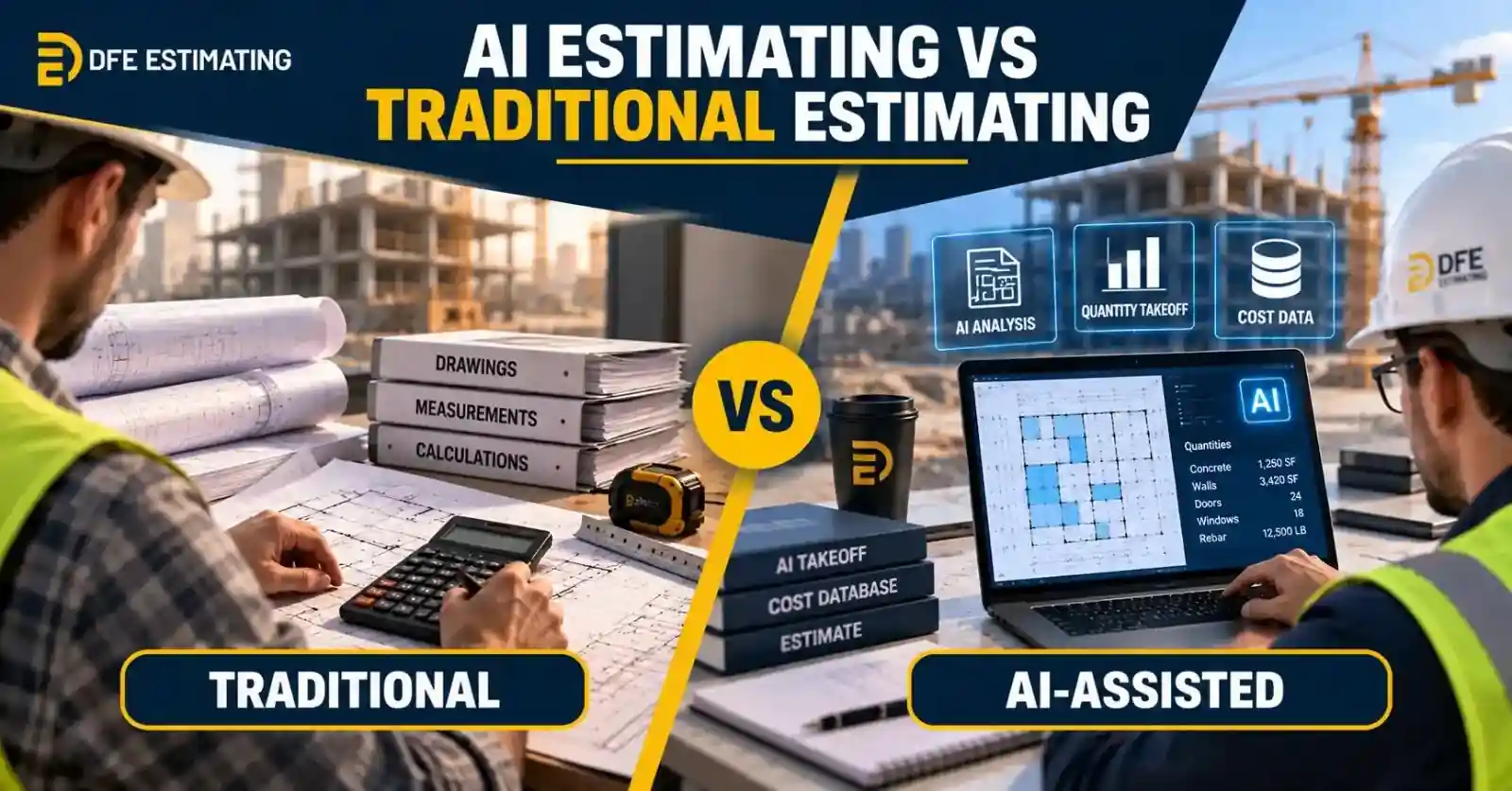
The main difference between traditional and AI-assisted estimating is how repetitive work is handled. Traditional estimating relies more on manual review and measurement. AI construction estimating can automate parts of the process, while experienced estimators remain responsible for scope, methods, risk, and final decisions.
| Estimating Task | Traditional Approach | AI-Assisted Approach |
| Drawing review | Manual | AI-assisted |
| Quantity takeoff | Manual measurement | Automated assistance |
| Object detection | Manual | Computer vision |
| Data processing | Manual | Automated |
| Revision comparison | Manual | AI-assisted |
| Historical cost analysis | Manual research | Data-driven |
| Cost prediction | Estimator models | Predictive models + estimator |
| Scope interpretation | Human | Human |
| Construction methodology | Human | Human |
| Risk judgment | Human | Human-supported |
| Final estimate | Estimator | Estimator + AI |
Key Takeaway
AI can improve speed, data processing, automated quantity takeoff, and machine learning cost prediction, but it does not replace construction knowledge. Scope interpretation, construction methodology, pricing decisions, and risk judgment still require experienced professionals.
The strongest model in 2026 is not AI versus humans. It is AI plus experienced estimators.
How Accurate Is AI Construction Estimating?
AI construction estimating accuracy depends on the quality of the drawings, project data, pricing information, software capabilities, and human review. AI can improve speed and consistency, but its results are not automatically accurate for every project.
Several factors can affect the outcome:
- Drawing quality: Clear, complete plans are easier for AI to analyze. Incomplete or unclear drawings can lead to missed quantities.
- Project complexity: Simple projects may be easier to process than complex commercial or industrial work with many systems and trades.
- Specifications and BIM quality: Missing specifications or poor model data can affect BIM quantity takeoff and cost analysis.
- Pricing and location: Construction costs vary by location, labor rates, and material prices. Current pricing data is important.
- Historical data: Machine learning cost prediction depends on relevant, reliable, and fresh project data.
- Unusual conditions: Special materials, difficult site conditions, or unique construction methods may require professional judgment.
AI tools also report different results for different tasks. For example, Togal publishes a 98% accuracy claim for floor plans, while other platforms report different task-specific results. These figures should not be treated as a universal accuracy standard.
For reliable AI construction estimating, experienced estimators should verify quantities, scope, pricing, assumptions, and final costs before an estimate is used for bidding or planning.
Benefits of AI in Construction Cost Estimating
AI can make construction estimating faster and more organized by handling many repetitive tasks. It does not replace the estimator, but it can give professionals more time for work that requires construction knowledge and judgment.
Key benefits include:
- Faster quantity takeoffs: AI can assist with measuring and counting items from digital drawings.
- Faster bid preparation: Automated data processing can reduce time spent preparing estimate information.
- Less repetitive work: Tasks such as counting, sorting, and document review can be streamlined.
- Better data organization: Digital estimating tools can bring project quantities, pricing, and historical information together.
- Faster revision checking: AI can help identify changes between drawing versions.
- Increased estimating capacity: Teams may be able to review more projects within the same time.
- More consistent workflows: Standardized digital processes can reduce avoidable manual steps.
- Better historical analysis: AI can help identify patterns in previous project costs and support predictive cost modeling.
- More time for high-value work: Estimators can focus on scope, risk, pricing, value engineering, and final review.
The goal is not guaranteed profit growth. The practical benefit is a more efficient AI-assisted estimating workflow that supports better use of an estimator’s time.
Limitations and Risks of AI Construction Estimating
AI can improve estimating workflows, but it has clear limitations. Understanding these risks helps teams use AI construction estimating responsibly.
- Poor drawing quality: AI cannot reliably interpret information that is missing, unclear, or inconsistent in construction plans.
- Outdated cost data: Even accurate quantities can produce a poor estimate when material, labor, or local pricing is outdated.
- Scope gaps: AI may identify visible elements without fully understanding project intent, specifications, assumptions, or exclusions.
- Complex construction methods: Unusual conditions and specialized work often require experienced construction judgment.
- Data quality: Machine learning cost prediction and predictive cost modeling depend on relevant, accurate historical data. Poor data can produce poor forecasts.
- False confidence: An AI-generated number may look precise while still missing important project details.
- Human oversight: Professional review remains essential before using an AI-assisted estimate for bidding or planning.
The safest approach is to use AI as a support tool, not as the final authority. Experienced estimators should verify quantities, pricing, scope, assumptions, and risks before approving the final estimate.
A Practical AI-Assisted Construction Estimating Workflow

A reliable AI-assisted construction estimating process combines digital tools with experienced estimator review. A practical workflow looks like this:
- Collect project documents: Gather drawings, specifications, addenda, and available project information.
- Review the scope: Confirm what work is included, excluded, or unclear.
- Analyze the drawings: Use digital or AI-assisted tools to review plans and identify relevant elements.
- Generate a preliminary takeoff: Extract quantities and measurements using automated quantity takeoff tools.
- Review the quantities: An estimator checks AI-generated measurements for errors or missing items.
- Apply current pricing: Add relevant material, labor, and equipment costs.
- Compare revisions: Check drawing sets for changes that may affect quantities or costs.
- Review scope gaps: Look for missing work and unclear requirements.
- Validate assumptions: Confirm methods, allowances, and exclusions.
- Prepare the final estimate: The experienced estimator reviews and approves the final bid.
This approach uses AI for speed while keeping professional judgment at the center of the estimating process.
Construction Technology Trends in 2026
Construction technology in 2026 is moving toward connected tools that combine AI, estimating data, and project information in one workflow. AI-assisted takeoffs can help identify objects and quantities, while predictive analytics supports cost forecasting and historical data analysis. Key trends include:
- BIM and 5D BIM: Linking models, quantities, and cost data supports more connected estimating.
- Cloud estimating: Teams can access project information and collaborate from different locations.
- Connected cost databases: Estimating systems can connect pricing and project data for easier analysis.
- Automated document analysis: AI can review drawings and other project documents to reduce manual work.
- AI assistants: Natural language tools can help users research data and compare estimate versions.
- Revision detection: AI can help identify changes between drawing or estimate versions.
- Digital collaboration: Connected platforms allow project teams to share data and maintain a common source of information.
The larger trend is clear: AI is increasingly being embedded directly into estimating workflows, rather than used as a separate tool. Trimble’s 2026 MEP estimating updates are one example of this shift.
What the Future of Construction Cost Estimating Looks Like
The future of construction estimating is likely to be AI-assisted estimating, not estimator-free estimating. AI will continue to automate repetitive tasks, but professional construction knowledge will remain essential for making reliable decisions.
Future systems are likely to connect:
BIM + AI + Takeoff + Cost Data + Estimating + Project Management
This connected approach can make AI construction estimating, automated quantity takeoff, predictive cost modeling, and construction cost forecasting more efficient. Estimators may spend less time collecting and organizing data and more time reviewing results and managing project risk.
However, technology cannot fully replace:
- Context: Understanding the project and site
- Judgment: Choosing practical construction approaches
- Risk: Identifying conditions that data may miss
- Scope: Understanding specifications, inclusions, and exclusions
- Final decisions: Approving the estimate and bid
For DFE, the opportunity is to combine evolving digital estimating technology with experienced professional judgment. AI can make estimating more efficient, but people still make the decisions that matter.
Why Professional Estimators Still Matter in an AI-Assisted Workflow
AI can speed up estimating, but experienced estimators provide the judgment needed to turn data into a reliable, bid-ready estimate. They can interpret complex drawings, check AI output, validate quantities, and apply current local pricing.
Professional estimators also understand construction methods and can review the full scope for missing work, exclusions, assumptions, and project risks. These areas are especially important when plans are incomplete or a project includes unusual requirements.
A strong AI-assisted workflow therefore combines technology with human expertise:
- Check AI-generated quantities
- Review drawings and specifications
- Validate pricing and cost data
- Confirm scope and exclusions
- Assess project risks
- Prepare the final bid-ready estimate
DFE provides professional construction cost estimating and quantity takeoff services for residential, commercial, and industrial projects. Its estimating workflow uses tools such as PlanSwift, Bluebeam, Trimble, RSMeans, and Xactimate to support detailed estimating work.
Conclusion
AI is changing construction cost estimating by making repetitive tasks faster, improving data organization, and supporting automated quantity takeoffs, drawing analysis, and cost forecasting. Tools using AI, machine learning, BIM, and predictive analytics can help estimating teams handle project information more efficiently.
However, AI construction estimating is not a replacement for professional expertise. Drawing quality, pricing data, project complexity, scope, construction methods, and unusual site conditions can all affect the final result. Experienced estimators are still needed to verify quantities, review assumptions, assess risk, and make final pricing decisions.
The strongest approach in 2026 is AI-assisted estimating, where technology handles repetitive work and professional estimators provide the judgment behind the final estimate. As BIM, AI takeoff software, predictive cost modeling, and digital estimating tools continue to develop, construction companies can build faster and more connected estimating workflows without losing the human expertise that reliable
Frequently Asked Questions
AI construction estimating uses artificial intelligence to assist with drawings, takeoffs, cost data, and forecasting.
It analyzes quantities, pricing, historical data, and project information to support cost calculations.
Yes. AI can assist with automated quantity takeoffs, but results should be reviewed by an estimator.
It is software that uses AI to support takeoffs, drawing analysis, cost data, and estimate preparation.
Accuracy depends on drawings, data quality, pricing, software capabilities, and human verification.
No. AI can automate tasks, but estimators still provide scope, risk, methodology, and final judgment.
It uses software to identify and measure construction elements from digital drawings.
AI can use computer vision to identify objects, measurements, and drawing information.
It uses project and cost data to estimate possible future construction costs.
AI is faster for some repetitive tasks, while traditional methods still offer important human judgment.
Poor drawings, outdated pricing, incomplete scope, complex methods, and poor data can affect results.